
Choosing a TRT Provider: Your GP, a Large Telehealth Platform, or a Physician-Led Practice
Quick Answer
Testosterone replacement therapy is more widely available today than at any point in the past decade. That accessibility is genuinely good news for the millions of men with undertreated hypogonadism. But availability and quality are not the same thing. Your primary care physician, a high-volume telehealth platform, and a physician-led practice all offer TRT. The clinical experience, depth of management, and outcomes you can expect from each are meaningfully different. Understanding those differences before you start is worth your time.
Key Takeaways
- Most primary care physicians manage testosterone to a normal range, not an optimization range, and often lack the specialized training to individualize protocols
- Large telehealth TRT platforms are built for volume, which typically means standardized protocols, limited physician access, and inconsistent estrogen management
- Physician-led practices offer personalized protocols, direct physician access, and ongoing monitoring that adjusts to how you actually feel, not just your numbers
- The estradiol assay your provider uses matters: the wrong test produces unreliable results that lead to unnecessary medication
- Ongoing monitoring is not optional in TRT. It is where the real clinical work happens
The Primary Care Approach: Normal Is Not the Same as Optimal
Primary care physicians are generalists. That is their strength for most of medicine. For testosterone optimization, it is a limitation.
When a GP evaluates testosterone deficiency, they are typically working within the framework of treating hypogonadism as defined by major guidelines: a total testosterone level below roughly 300 ng/dL paired with clinical symptoms. If your number falls within what the lab flags as normal, many GPs will not initiate treatment regardless of how you feel. The AUA and Endocrine Society guidelines are designed for population-level diagnosis, not individual optimization.
The distinction matters. A man with a total testosterone of 480 ng/dL who is exhausted, losing muscle mass, sleeping poorly, and experiencing low libido may be a strong candidate for TRT. A GP trained to treat the number, not the person, may tell him his levels are fine. They are normal. They are not necessarily optimal for him.
Beyond the threshold issue, most primary care physicians have limited familiarity with the nuances that determine whether a patient does well on TRT.
Free testosterone and SHBG. Total testosterone tells only part of the story. A significant portion of circulating testosterone is bound to sex hormone binding globulin (SHBG) and is biologically inactive. Two patients with identical total testosterone levels can have dramatically different amounts of free, active testosterone depending on their SHBG. Most GPs do not routinely measure SHBG or factor it into dosing decisions.
The right estradiol assay. Standard immunoassay estradiol tests, designed for women, are unreliable in men. They cross-react with other steroids and produce inaccurate results, particularly at the lower ranges where most men on TRT actually fall. The clinically correct test is LC-MS/MS (liquid chromatography-tandem mass spectrometry), sometimes called sensitive or ultrasensitive estradiol. Many primary care physicians are unaware of this distinction and order the wrong test. Decisions made on inaccurate estradiol values lead to unnecessary prescriptions and unnecessary side effects.
Divided dosing. Testosterone cypionate is typically administered by injection. Once-weekly injections are common but produce significant peaks and troughs in hormone levels. Twice-weekly or more frequent smaller injections produce more stable levels throughout the week, reduce estradiol surges, and generally produce better symptom consistency. Many GPs prescribe once-weekly dosing because it is the familiar standard, not because it produces the best outcomes.
Aromatase inhibitor prescribing. A significant number of primary care physicians prescribe aromatase inhibitors (AIs) reflexively when a patient’s estradiol comes back elevated on a lab report. The 2013 Finkelstein study published in the New England Journal of Medicine established clearly that estradiol is not the enemy on TRT. Estradiol deficiency in men on TRT is associated with decreased libido, increased fat mass, joint pain, mood disturbances, and accelerated bone loss. Reflexive AI prescribing based on a number, without symptom assessment, is frequently more harmful than the elevated estradiol it was intended to address. The Endocrine Society and the AUA explicitly do not recommend routine AI co-administration in TRT patients.
The Large Telehealth Platform: Convenience Built for Scale
The growth of telehealth TRT has made care accessible to men who previously had no realistic options. That is a genuine contribution. But the business model of most large TRT telehealth platforms creates structural limitations that affect the quality of care a patient receives.
Platforms like Hone Health, Fountain TRT, and Maximus Tribe operate at significant scale. Thousands of patients, streamlined onboarding, competitive pricing. The economics of that model require standardization. That standardization is where the clinical tradeoffs begin.
Nurse practitioner vs. physician supervision. Many large telehealth TRT platforms are staffed primarily by nurse practitioners or physician assistants operating under physician oversight. The degree of that oversight varies considerably. An NP following a standardized protocol is not the same as a physician with subspecialty interest in hormone optimization managing your care directly. The distinction matters most when your case does not fit the standard protocol, which is common in TRT management.
Standardized starting protocols. High-volume telehealth platforms typically initiate patients on the same starting dose regardless of their individual presentation. A standard protocol has to work reasonably well for most people. It is designed for the average patient. If your SHBG is significantly elevated, if your estradiol conversion rate is unusually high, if your symptom presentation is atypical, a protocol written for the median patient may not serve you well.
Limited physician access. The care model at most large telehealth TRT platforms is primarily asynchronous. Questions go through a messaging interface. Follow-up is often scheduled on a fixed cadence rather than driven by clinical need. The physician relationship that most patients expect when they think about medical care does not typically exist in the volume telehealth model. You are more likely to interact with a care coordinator than with the physician who prescribed your protocol.
Estrogen management patterns. Because estrogen management at scale requires clear decision rules, many telehealth platforms apply more aggressive estradiol thresholds than the current evidence supports. A patient whose estradiol rises above a threshold may receive an aromatase inhibitor as an automatic protocol step, regardless of whether they have symptoms of estrogen excess. Over-suppression of estradiol is a real clinical problem that many TRT patients have experienced after starting care on a high-volume platform.
Ongoing monitoring as a variable. Follow-up lab cadence varies significantly across platforms. Some perform thorough monitoring at appropriate intervals. Others offer minimal follow-up. A patient who starts TRT and goes six or twelve months without comprehensive lab review including hematocrit, PSA, estradiol, and testosterone levels is not receiving adequate care, regardless of how they feel.
What Physician-Led TRT Management Actually Looks Like
The alternative to both extremes is a practice model built around what TRT management actually requires: a physician with genuine expertise in hormone optimization, managing each patient individually, with monitoring that reflects clinical reality rather than an administrative schedule.
In a physician-led model, candidacy for TRT is determined by the intersection of lab values and how the patient actually presents. There is no minimum testosterone number that automatically qualifies or disqualifies someone. A patient with a total testosterone of 500 ng/dL who has significant symptoms across multiple domains may be a stronger candidate than one at 320 who feels generally well. The labs inform the decision. They do not make it.
The initial evaluation goes beyond total testosterone. A complete baseline panel includes free testosterone, SHBG, LH, FSH, sensitive estradiol (LC-MS/MS), CBC with hematocrit, PSA, comprehensive metabolic panel, prolactin, lipid panel, and TSH. Each of these has clinical relevance to both the decision to initiate treatment and the management of that treatment over time.
Estrogen management in a physician-led practice follows the evidence rather than reflexive thresholds. The Finkelstein 2013 NEJM data established that estradiol is an essential hormone in men, contributing to libido, bone mineral density, cardiovascular health, and cognitive function. An elevated estradiol number on a lab report, in the absence of clinical symptoms of estrogen excess, is not an indication for treatment. Aromatase inhibitors are reserved for patients with genuine, documented symptoms of estrogen excess, after non-pharmacological interventions have been attempted and documented.
Ongoing Monitoring Is Where the Real Clinical Work Happens
Initiating TRT is the beginning of the clinical relationship, not its substance. What determines whether a patient does well over time is the quality of monitoring and the willingness to adjust the protocol based on what the monitoring shows.
Comprehensive ongoing monitoring includes total and free testosterone at trough, sensitive estradiol (LC-MS/MS), SHBG, CBC with differential (hematocrit is a safety parameter, not optional), PSA with defined escalation thresholds, comprehensive metabolic panel, and a structured symptom assessment at every visit.
The symptom assessment is not administrative. It is clinical data. A patient whose labs look good but who reports declining energy, mood changes, or worsening sleep quality has something worth investigating. The numbers do not always tell the full story. A physician who asks, listens, and adjusts accordingly provides a different category of care than one who looks at a lab value and moves on.
When monitoring catches something, the response needs to be proportionate and evidence-based. Hematocrit above 54 percent requires holding TRT and a phlebotomy referral. A PSA increase above defined thresholds requires urology evaluation. Estradiol below 20 pg/mL with symptoms requires investigation for over-suppression, not another aromatase inhibitor. These decisions require a clinician who understands the protocol, knows the patient, and has time to think through the presentation.
Questions Worth Asking Before You Start TRT Anywhere
- Is my care managed by a physician, or by an NP or PA under physician oversight?
- Which estradiol assay do you use?
- What is your approach to estrogen management?
- How do you factor SHBG into dosing decisions?
- What does ongoing monitoring look like? What labs, on what schedule, and who reviews the results?
- How do I reach my physician if I have a concern between scheduled visits?
The Practical Bottom Line
TRT is not complicated to start. It is complicated to manage well over time. The difference between a good outcome and a frustrating one often comes down not to the medication itself but to the quality of the clinical relationship around it: the initial evaluation, the protocol design, and the ongoing monitoring that catches what needs adjusting.
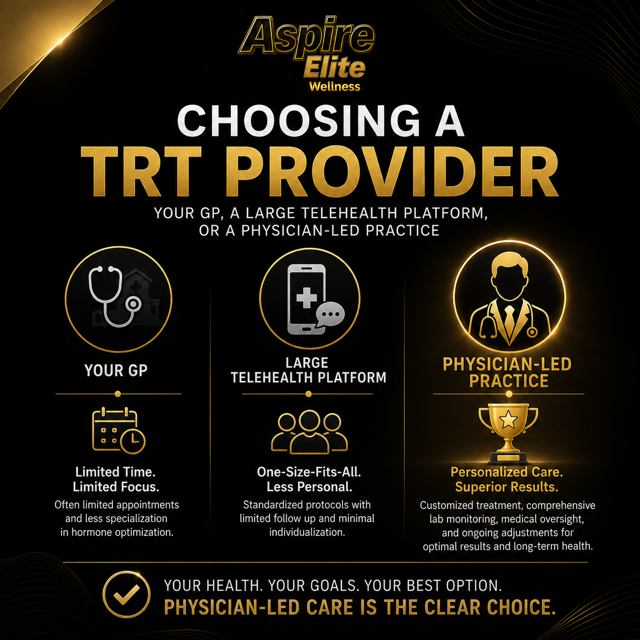
A primary care physician can initiate TRT, but the training, time, and framework typically are not designed for ongoing optimization. A high-volume telehealth platform can make TRT accessible, but the model optimizes for scale, not for the patient who does not fit the standard protocol. A physician-led practice with genuine subspecialty focus manages TRT the way the evidence says it should be managed: individually, comprehensively, and with monitoring that reflects clinical reality.
That distinction is worth understanding before you start.
Frequently Asked Questions
What is the difference between a physician-led TRT practice and a telehealth TRT platform?
The primary difference is the care model. Physician-led practices have a licensed physician directly managing each patient’s protocol, with individualized evaluation and ongoing monitoring. Most high-volume telehealth platforms use standardized protocols managed by nurse practitioners or physician assistants under physician oversight. For straightforward patients who fit the standard protocol, that model can work. For patients with atypical presentations, high or low SHBG, or estrogen management complexity, a physician-led model typically produces better outcomes.
Why does the estradiol test my doctor orders matter?
Standard estradiol immunoassay tests are designed for female reference ranges and cross-react with other steroids in men. They are unreliable at the lower values where most men on TRT fall. The LC-MS/MS assay is the clinically validated test for men and produces accurate results. Clinical decisions based on inaccurate estradiol values frequently lead to unnecessary aromatase inhibitor prescriptions and the side effects that come with them.
Is a high estradiol level on TRT dangerous?
Not necessarily. The 2013 Finkelstein study in the New England Journal of Medicine demonstrated that estradiol is an essential hormone in men, contributing to libido, bone mineral density, cardiovascular health, and cognitive function. An elevated estradiol number without clinical symptoms of estrogen excess generally does not require treatment. The more clinically significant risk is estradiol suppression below 20 pg/mL, which is associated with decreased libido, joint pain, depressed mood, and accelerated bone loss.
What labs should be monitored on TRT?
Comprehensive TRT monitoring includes total and free testosterone at trough, sensitive estradiol (LC-MS/MS), SHBG, complete blood count with hematocrit, PSA, and a comprehensive metabolic panel. Each of these serves a specific clinical function: testosterone levels confirm therapeutic range, hematocrit is a safety parameter, PSA has urologic significance, and estradiol and SHBG shape dosing decisions.
What is SHBG and why does it matter in TRT?
Sex hormone binding globulin (SHBG) is a protein that binds testosterone and renders it biologically inactive. Only unbound, free testosterone produces clinical effects. Two patients with identical total testosterone of 700 ng/dL can have very different amounts of biologically available testosterone depending on their SHBG levels. A patient with high SHBG may remain symptomatic despite a total testosterone that looks adequate on paper. Accounting for SHBG in dosing decisions is a marker of a clinically sophisticated TRT practice.
Can my primary care physician manage my TRT?
Technically yes, but there are meaningful limitations. Most primary care physicians are trained to diagnose and treat clinical hypogonadism using population-based thresholds, not to optimize hormone levels for individual patients. The nuances of free testosterone interpretation, SHBG-adjusted dosing, LC-MS/MS estradiol, divided injection protocols, and evidence-based estrogen management are generally outside the scope of standard GP training. Some primary care physicians with a specific interest in men’s health develop this expertise, but it is not the norm.
What is the right hematocrit threshold on TRT?
Hematocrit above 54 percent is the threshold at which TRT should be paused and phlebotomy considered, per Endocrine Society guidance. Elevated hematocrit increases blood viscosity and is associated with increased cardiovascular and thrombotic risk. This is why CBC with hematocrit is a non-negotiable component of TRT monitoring.
About the Author
Dr. Chris Van Smith, DO, is the co-founder and supervising physician at Aspire Elite Wellness. He specializes in hormone optimization, testosterone replacement therapy, medical weight loss, peptide protocols, and longevity medicine. Dr. Van Smith practices concierge-level telehealth care, working directly with each patient to build individualized protocols based on comprehensive lab work and personal health goals. Every Aspire patient has a direct relationship with Dr. Van Smith, not a rotating provider or automated system. He is based in Florida and serves patients statewide.
This content is for informational purposes only and does not constitute medical advice. All treatment requires evaluation, diagnosis, and ongoing monitoring by a licensed physician. Individual results vary.
References
Finkelstein JS, et al. Gonadal Steroids and Body Composition, Strength, and Sexual Function in Men. New England Journal of Medicine. 2013. https://www.nejm.org/doi/full/10.1056/NEJMoa1206168
Lincoff AM, et al. Cardiovascular Safety of Testosterone-Replacement Therapy. New England Journal of Medicine. 2023. https://www.nejm.org/doi/full/10.1056/NEJMoa2210358
Bhasin S, et al. Testosterone Therapy in Men With Hypogonadism: An Endocrine Society Clinical Practice Guideline. Journal of Clinical Endocrinology and Metabolism. 2018. https://pubmed.ncbi.nlm.nih.gov/29562364/
Mulhall JP, et al. Evaluation and Management of Testosterone Deficiency: AUA Guideline. American Urological Association. 2018, updated 2022. https://www.auanet.org/guidelines-and-quality/guidelines/testosterone-deficiency-guideline
Ramasamy R, et al. Serum estradiol levels are associated with decreased libido and erectile dysfunction in older men. Journal of Urology. 2014. https://pubmed.ncbi.nlm.nih.gov/24077296/